
The Resilient Programmer
Four pillars for economic crisis.

Introduction - The 2023 Crisis
We are in the midst of an economic crisis. Whether we want to admit it or not, the 2022-2023 crisis is becoming more tangible, even in the IT industry.
Restrictions and project closures, no new projects starting, rumors of layoffs. Recently, an IT company in Cluj closed down and moved its operations to cheaper countries. Something unheard of in the recent history of Europe's Silicon Valley.
Some analysts say that we are facing a crisis of greater proportions than the 2008 crisis. Time will tell if this is true or not.
But I will not try to prove in this article whether there is a crisis or not. My personal opinion is that we are in a crisis, and for me, it is enough to try to prepare as well as possible for such a situation.
Although I have been through several economic crises and have seen the concrete unfortunate effects of the economy's collapse, I realize that people are very different and personal situations are complex and vary greatly from person to person.
That is why I cannot afford to give advice on what you should do in this crisis, I only present FOUR PILLARS that I have found useful in my life and that can help you in a crisis too.
But before presenting the four pillars, I would like to create a Framework of Thinking.
Mindset
Unlike animals, humans have a much more complex capacity for thinking. Thanks to this gift, we are not predetermined to react reflexively to any stimulus. If you receive a slap, you could decide not to respond with violence. But I wouldn't try to put my hand in the plate of a dangerous dog, I would surely get my reward and leave with bandaged fingers.
That's why it's very important to constantly analyze our lives and the situations we go through. The framework or perspective from which we think about the problems we face makes a huge difference in our actions and reactions to those problems.
This framework doesn't form overnight. We can't force ourselves to produce a better "self" like a hen lays an egg. The mindset is built drop by drop, from what we feed ourselves mentally and spiritually, from the intellectual water we drink, from what we seek with all our heart.
Difficult situations also have a good side, which is that they confront us with something unpleasant, something that challenges us to analyze and improve our mindset. The person who experiences difficult situations and constantly learns from them has the chance to be a better person.
You might be wondering what all this philosophizing has to do with the crisis we're in. The Rome is burning and we are doing philosophy.
Well, it does, because depending on the framework you have, you will react better or worse. For example, it may be very important to you to have a lot of money. And because your company can't increase your salary this year, you suddenly decide to go to another company. You might go to a newer company that offers you more, but after a month, you find out that the new company, because it's just starting out, has bigger money problems and will lay you off.
A counter-example would be to value your role in supporting your family and choose to stay at the company you're at, even if your salary is not at the expected level, for their safety.
Specifically, what I propose is that you analyze your mindset, see where you are and if you have something to clarify at this level. When I clarify and remind myself what's most important to me, the direction I will take will be clearer.
But let's move on to the crisis plan.
Pillars of the Crisis Plan
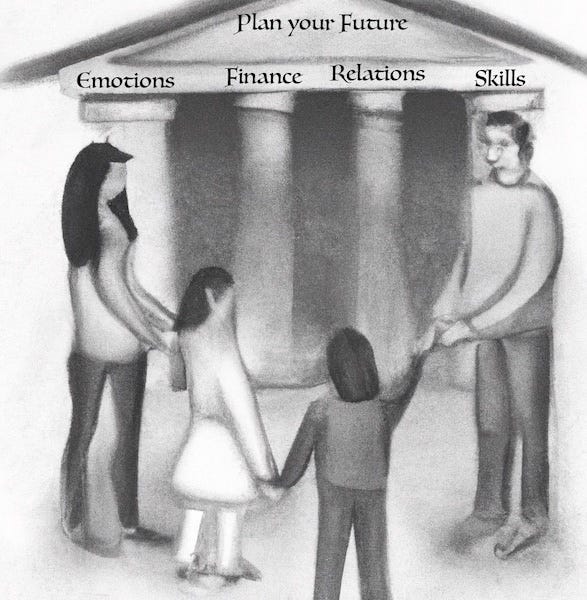
The Emotional Pillar
If I don't have my emotions under control in a crisis situation, I can make the most disastrous decisions.
I might choose to change my company and lose my job.
I might buy an apartment and then the real estate market could decline and I could find out that I paid twice the real value for it.
I might suddenly dive into the world of bitcoins or the stock market and lose everything.
I might let work worries consume me and destroy my family.
Basically, I see 5 points that help me emotionally:
Don't panic. At the beginning of the road, it's easy to lose my balance, but after decades of experience, I can tell you that there is no problem without a solution. Not always the solution is the one I want, but there are ways out of problems.
To know myself as well as possible and to know clearly where I am vulnerable, there I strengthen the wall harder, put more props.
I analyze each decision in much more detail, objectively, with numbers. I put on paper what the worst and best scenario is. I try to understand the impact of the worst-case scenario.
Advice from others. In important decisions, especially in crisis situations, I try to consult with specialists. "A multitude of advisors brings victory," says a proverb.
Action. When I'm in a crisis, there's a risk that I'll freeze and not want to act in any direction, meaning that I'll tell myself that no matter what I do, it will still turn out bad. I try not to indefinitely delay important decisions and to apply them even if they are unpleasant.
The Financial Pillar
In an economic crisis, the most direct impact is on the first pillar that is attacked, the financial one.
I can lose my source of income or be stressed that I will lose it.
Building the financial pillar takes a lot of time, and if I am not prepared when the crisis comes, it may collapse under pressure.
What does it mean to be financially prepared for a crisis? It means having enough resources to allow me to withstand the financial impact until I regain my income. To be able to pay rent or mortgage, food, and the necessities for my family.
As practical steps:
Have an emergency fund. To be prepared for a crisis, I estimate a minimum of 3 months' salary set aside in an emergency fund. It is recommended to save up to 6 months' salary, and for peace of mind, I would save up to 12 months' salary.
Mr. Budget. Budgeting is the procedure to stop financial bleeding. If I don't have a budget on paper or at least a mental one that limits my spending, I will definitely have financial leaks and lose money. I create a budget that reduces all expenses to a minimum
I try to help those with greater problems than mine. We, programmers, are among those who earn better than the average population, so we can certainly allocate a portion of our income to help those in need.
The Relational Pillar
In a crisis, the help I receive from others or the help I offer is much more valuable. When I'm down or upset, a kind word is worth a thousand when I'm happy and peaceful.
At the same time, the more active I keep my relationships with friends and acquaintances, the easier it is for those in our group who have job problems to find work.
Practical steps:
The relationship with family is the most important. Through thick and thin, we are together and must offer each other the greatest help.
The relationship with friends and colleagues - I keep in constant contact and am informed about the market and economic situation. I am also ready to help as much as I can. I try to expand my social circle and participate in technical, cultural, and religious forums.
The Technical Pillar
This is a determining factor in terms of the job. If I am technically good, I have a better chance of staying afloat.
But this pillar is just as difficult to build as the financial one. It requires constant investment and energy.
I don't have much to do technically if decisions are made next week about who stays in the company and who leaves.
However, I practically see a few steps that can help me in a crisis situation.
Dust off my CV and resume. If I don't have one, it's vital to write one as quickly as possible, to put my technical business card on paper, what I know how to do, and what I've done well.
Based on what I've put on my resume, I evaluate myself to see what I could have done better. I try to compare myself with my colleagues to see what they know that I don't. If I'm falling behind, I identify these areas.
I make an improvement plan, short-term (urgent), medium-term, and long-term.
I start implementing the plan. One of the most important motivators is outside my door - job loss, salary reduction. I try to use this factor to give my career a new impetus.
Plan Your Future
Out of the whole crisis, this is the most important aspect.
Like a dome that gathers all the support of the pillars and provides protection, the FUTURE PLAN represents what I have learned from this crisis and what I will do after the crisis ends, how I will prepare and train for the next crisis.
The crisis will surely come, not in one or two years, but within 10-15 years we will definitely hit another threshold.
If after this crisis, my life returns to the inefficient normalcy before the crisis, in which I did not invest much in the aforementioned pillars, then everything was in vain. In the next crisis, the situation will be more serious. Years will pass, and I will be more and more depreciated and unprepared for the waves that break everything that is not strongly anchored.
Therefore, if you are interested in developing these pillars, I will briefly present some materials that I use and see as very helpful.
Books for the Financial Pillar
Many programmers I know are not too interested in a financial plan. If you're young and just starting out, you might think that you have a low salary and it's not worth saving money. Maybe you tell yourself, "I'll start saving when I have a higher salary, and then everything will be fine in the end." And so time passes, and you don't form this habit, this "financial muscle."
Two lessons I learned late and regret not applying earlier are budgeting and consistent investing.
I don't want to tire you with my, probably brief, understanding of the two concepts, but a financial master helped me: Dave Ramsey, who is a celebrity in American financial education.
I really enjoyed Dave Ramsey's book, "The Total Money Makeover," which takes you by the hand and shows you step by step how to use your income wisely so that you can enjoy long-term prosperity.
Recently, I also read Dave Ramsey's latest book, "Baby Steps Millionaires," which shows how normal people like us, through diligence, consistency, and a clear financial direction, can accumulate financial strength in a healthy way, not through tricks, schemes, or speculative investments.
Books for the Technical Pillar
The technical pillar depends on the direction and programming language you have chosen, but the foundation of programming is the same. In the careers of successful programmers, a solid foundation at the beginning helps a lot in the efficient development of their careers. If you have a good understanding of the principles, it will be very easy for you to build knowledge in any language, technology, or framework on top of this stable foundation.
Robert C. Martin's books, are a reference: "Clean Code," "Clean Architecture," and if you have access, he also offers a series of video materials inspired by these books (Clean Coders). From him, you can learn the well-known SOLID principles in the programming world.
In addition to principles, it is important to master at least one programming language, with details related to more complex concepts such as multi-threading. For Java programmers, Brian Goetz has a very important book: "Java Concurrency in Practice."
I will mention only 5 essential books here; the complete list is too long, and we will leave it for future material.
Books for the Emotional/Relational Pillar
The area here is vast beyond measure. We're talking about Philosophy, Religion, and Psychology.
Moreover, we programmers are the worst at this. We prefer interacting with machines rather than with people.
I will recommend what has helped me. The materials suggested may not be agreed upon by everyone, and it's normal and good that it should be so, but ultimately, I remind you that in this article, I present what I have seen practically work for me.
I'll start with the book that I feel is the most important book in humanity, the New Testament, followed by two small books full of wisdom: Solomon's Proverbs and Ecclesiastes.
I'm surprised at how few young people have read these books. They are probably influenced or frightened by the increasingly derogatory images associated with Christianity.
Even if you don't agree with Christianity, it's worth reading these books, to see first-hand the ideas that completely changed humanity and civilization. Without reading the Bible, you'll lose a lot of understanding of human nature and the most valuable works of art, literature, painting, or historical events.
Regarding decisions, a book that helped me with a practical framework for decisions is Ben Carson's book - Take the Risk: Learning to Identify, Choose, and Live with Acceptable Risk.
Regarding relationships, two books come to mind: Dale Carnegie's "How to Win Friends and Influence People" and Gary Chapman's "The Five Love Languages."
And I'll conclude the list with Jordan Peterson, who proposes the 12 Rules for Life, which I see as simple, practical, and useful. They can bring clarity and emotional balance in crisis situations.
I would like you to write to me about what materials have helped you in times of crisis or in building solid pillars that can withstand the pressures of life.